
Four books in three weeks. That’s how captivating Statovci’s books are. While his writing may not be for everyone, it is something everyone should be aware of. Pajtim Statovci is a Finnish author, born in Kosovo, who immigrated with his family to Finland when he was two years old. Two of his books have been awarded Finland’s highest literary honour, the Finlandia Prize.
If I had to describe his books in a nutshell, I would say they are about the same things, but different every time. They are about Albania, Kosovo, Finland, migration, belonging, identity (migrant, cultural, sexual, and gender), violence, relationships… The symbols of the cat and the snake are also very present in his work, both mythically and physically.
The first book I read was his latest novel, called Lehmä synnyttää yöllä in the original Finnish (in English: A Cow Gives Birth at Night). It was translated into my native language this year, and it immediately caught my attention. After reading three other books by Statovci, I can also honestly say that this one was the heaviest for me.
It portrays a migrant family living in Finland and coping with racism and misunderstandings from their host culture on the one hand. On the other hand, it shows a Kosovan reality full of stereotypical gender roles, where the father of the family is an unquestioned authority who rules with an iron fist. At the centre of the story is the youngest son, who is vulnerable in both environments – the Finnish one as well as the Kosovan one.
In the eyes of his family, he is somewhat delicate and does not understand the cruelty that surrounds him, especially during the regular visits of his grandparents to Kosovo. The book is written across two timelines and two locations, while we follow the struggle of the boy (and later young man) to understand who he is and what happened to him.
After that, I took all his available books from the library: My Cat Yugoslavia (Kissani Jugoslavia), Crossing (Tiranan sydän), and Bolla.
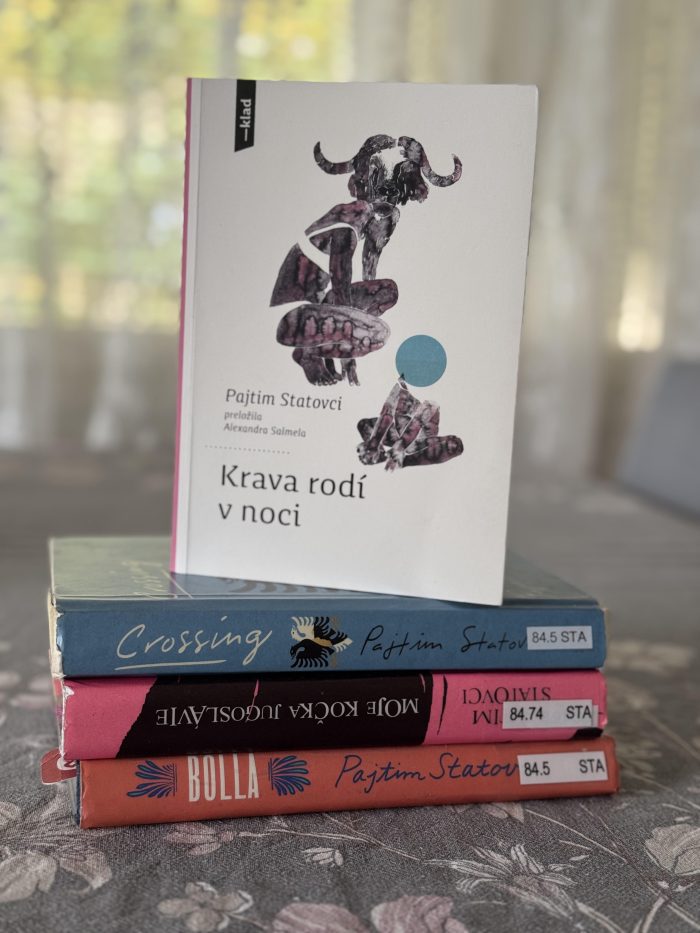
Crossing is the story of two young friends who decide to leave home and run away from Kosovo before the war starts. They both struggle with their sexual or gender identities and dream of a better, safer, and more accepting society. They survive on the streets of Tirana, saving money for their trip to Italy, where they hope to apply for asylum.
The story then continues to follow one of the friends. His restlessness pushes him to move from one country to another, develop new personalities, and create stories about his past. Eventually, this leads him back to Kosovo, to his parents’ house, where only his deteriorating, ageing mother remains, hoarding rubbish.
My Cat Yugoslavia and Bolla both describe the reality of arranged marriages in Kosovo families. In both novels, there is a man who hides his true sexual orientation. One of them dreams about living different lives with different partners, if only that were an option in a conservative Muslim culture. He leaves his lover behind and immigrates to Germany with his wife and children. But life there is no more liberating for him, as he must continue to obey the cultural expectations of his own community.
In the other novel, the protagonist eventually finds a life partner, which helps him cope with his family history and finally accept himself.
Statovci describes Kosovo’s culture and society with brutal honesty. He writes about family hierarchies and ever-present violence. He talks about people who lie to gain advantages, those who rape and sexually abuse children, and human trafficking. He openly describes the poverty and cruelty of everyday life.
He does not spare Finland in the process. He is equally truthful when talking about the hostility towards migrants, the lack of support and understanding, and the failure to recognise what migrant families are, what they need, and what challenges they face.
As I said at the beginning of this blog, Statovci’s books are not for everyone. But I have found in him one of the most interesting authors I have come across in the last year. I can still read about the topics he usually covers in his books, but I am also curious to see whether there is anything else he can offer his readers.
